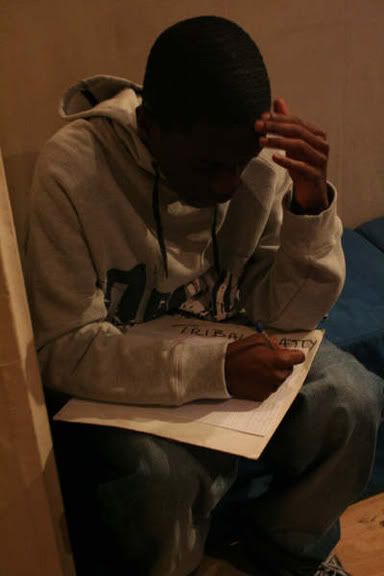
On the 18th March, Grime legend Jammer came to Brick Lane's VIBE BAR to help summarise and celebrate the hard work of the young people of Haggerston Youth Inclusion Project who completed a music course with the Gold Seal Project recently.
The event involved a seminar and live performance that helped the young people get a first hand, realistic insight into the music industry. All who attended had the opportunity to talk up close and personal with the established grime artist about the musical ups the downs, do's and dont's, personal experience, planning a career and witness a 15 minute PA of his latest material that can be seen soon in stores and shows across the world.
Jammer handed out the young peoples qualifications personally and commended them for their hard work to date.
The event was a smash hit and all who attended commented on how they found it useful and informative.
We look forward to the DJing course which will run during the summer of 2009.
For more info on any of the Gold Seal Project courses please check our website
Fresh off the back of his recent top 10 hit, Tinchy Stryder popped down to the project studio's to lay some bars with none other than Ruff Sqwad's finest Fuda Guy.
It was a heavy session but unfortunately nothing that we are allowed to give ya to hear.However,we wish him good luck in his future work - his current success couldn't have happened to a nicer guy!
Support the cause by buying his current single Take me Back ft Taio Cruz and what we do have are some pics of him in studio below!!
Finally we have a copy's of the hard work completed by the young people of Kensington & Chelsea that completed the summer Smile projected hosted at new media company YCTV's base.
The project was set to engage young people between the ages of 13-19 in Kensington & Chelsea to provide creative, constructive activities for them during their summer holidays. Special thanks goes to Derek @ Rugby Portobello Trust and Erin @ YCTV who sought funding to put the program together.
The theme for the course was to look at what makes the young people smile, to help spark some enthusiasm for those that may be surrounded by negative outputs in their day-to-day life.
Over the first 2 weeks of August, the Gold Seal team set about providing a producer and engineer who would help the young people capture their ideas musically, learning some of the practices required to create a track for them to write to and eventually record vocals. Needless to say, the young people set about working hard and 3 great tracks were created with vocals to inspire peers and demonstrate the practices required to complete this kind of task.
Check the final videos out below and see what hard work accomplishes!!
For details on projects similar to this please check the website or call the office today on 020 8743 0009 for a full assessment and exclusive program.
Following the success of last years music project at Haggerston's Youth Inclusion Project, where we incorporated DJing supplier Stanton to help buy the site some industry leading equipment. This year we put together a 45 hour course that would help 10 young people from South Hackney gain 3 accredited units each to reinforce the skills learnt. After some valuable lessons from the previous year, the team were set to provide a course that offers more constructive activities for young people in the borough.
The program devised saw top UK 1Xtra Radio DJ, DJ B help open the course and incorporated him as a tool to engage and inspire the young people to make constructive life choices and learn new creative skills.
Needless to say the course had good uptake and the young people set about learning everything from setting up the turntables, to beat matching, mixing skills, scratching and even some basic beat juggling. Check the pics below and for any budding DJ's in the making there is also some DJing tips listed on the blog to help improve your skills.
The grand finale finished at top local east London night club Herbal. Special thanks goes to the whole team there who accommodated us at short notice and helped make it a special event for all those that attended. Once again 1Xtra's DJ B joined us again to go back to back with the young people to help create a memory to last for all those that finished the course.
18 qualifications were issued and we look forward to next years course where we hope to offer a similar program for south Hackney based young people.
For more details on any Gold Seal courses please check the website and contact the office on 020 8743 0009 for a full assessment of your needs and an exclusive tailored program.
Just a quick post today to let you know about one of our favourite blogs ainthardtotell.com that has all the latest industry gossip, goings on, prospects downloads and opinions. Keep checking it on a daily basis to get the latest action, links and updates.
Having trawled the net for days to try and summarise and show you guys some of the best clips, blogs and websites to cover from the basics to the most advance DJing skills, I am generally quite disappointed. Most websites have huge amounts of text with little visual to help reinforce the pages of text, plus for the non academic learner its a mountain of words that need translating into actions.
However this one covers the basics for beat matching, similarly the full DJing for dummies guide is also worth a look/purchase/download from a torrent.
Also worth checking out Sonic academy's you tube page here. Make sure you check all 8 lessons as they are good to reinforce most of the teaching points we have covered in lessons.
As you get better and want to experiment with some scratches then there are some good clips on you tube put up by Q-Bert and Scratch Perverts which covers the scratching basics.
However I strongly recommend that you spend time learning the beat matching skills and listening to your mixing to improve how you actually sound to the listener before going crazy on learning scratches. I found the best way is to keep recording yourself and listening back analysing what worked and what didn't and why. The hardest part about DJing and DJing well, is to establish what will contribute to the best mixing out of the speakers and not the headphones. For my beginners years, I was convinced I was doing amazing and having a great time in the headphones, but what was actually playing was the complete opposite and definitely not a crowd pleasing performance. So spend time recording yourself and learning how to correct your mixing skills. In my eyes, a good DJ only uses their headphones to cue, correct mixing mistakes at the beginning to then drop a tune and for the occasional reference during their mix.
Once you have learnt how to beat match/mix then look at some scratches, they have loads of variations and names, because scratching is basically an artform and used to demonstrate your 'style' and originally for battling, which is where turntablism, (the art and use of two turntables to create new forms of music and tricks with the equipment) derived from.
Check the clips below for some of the basic scratches:
There are loads of home made, learn DJing clips on you tube so feel free to search away, but none that I feel really break it down clearly and can be reinforced and easily learnt from other than the DJing for dummies guide, qberts how to scratch lessons and for the advanced learner the scratch perverts. As a result I have decided to give you some tips and a few links for the mean time, however we will also make some clips in the near future and put them on you tube with tips as well.
Remembering this short little phrase will help you to understand how sound starts and travels through your set up, and also can be used to check and identify any areas along the way that is preventing sound from being heard.
Sound will start cut as a groove on your record which is then picked up by the needle, the needle takes the vibrations down the tone arm and progresses towards the mixer. At the mixer, provided that it is wired correctly, the sound will be fed into a channel strip and able to be controlled with either the gain, upfader and crossfader. The sound is then fed out from the mixer from a master output and an be fed to an amplifier. The amplifier will in turn make the sound louder which can then be fed to the speakers which finally turn the signal into an audible format which can be taken in by the human ear. Whilst this may appear simple, always checking this sound path will allow you to identify any errors and pin point where your sound will travel and be heard. You will be surprised with how simple errors will occur regularly along this path unless you check all five points regularly, especially before and after a mix.
RECORD - Right - Always check that the record is on the turntable the right way and that its turning at the correct speed (33, 45) with grooves available to be picked up by the stylus/needle.
NEEDLE - Now - Ensure that the needle isn't covered with dust, is still functioning and is ideally a diamond cut needle that can take being moved forwards and backwards. Also double check the obvious that its in the right place and on a vinyl that have grooves to be picked up.
MIXER - Make - Double check that you have connected the turntables/cdj's in the right ports (Turntables use phono inputs and CDJ's use the line inputs). Check that you have sufficient but not overloaded or peaking gain for each channel strip. Upfaders are used to control the volume of each channel during your mix. They are the DJ's mixing and fading tools and are used for fading sound in and out of the mix and can also be used for chopping between the two sources playing. The last area and one of the most important to check is the crossfader, always remember that the crossfader will play the sound that it ponits too. It is also the last part of the mixer that should be worked with to ensure that you have all the other areas sounding or cued correctly.
AMPLIFIER - A - This is the last point to check for power and levels. Try not to over amplify your sound either as this will blow your speakers if you are not careful. The last simple one to check is that your amplifier is turned on as well. Sounds obvious but is an easy one to forget.
SPEAKERS - Sound - Finally check your speakers are correctly plugged into your amp and are not blown. You will know if your speakers are blown as they will sound muffled and poor quality especially with certain frequencies.
LEARNING TO BEAT MATCH
I recommend using two identical tunes on vinyl if possible at the same tempo and practice looking for the 1 (the first beat on the record). Practice dropping the 1, once cued in the headphones, in time with the first beat of a bar on the record playing.
The next part is going to be the be all and end all of where you learn to understand and compute the beat matching element. You need to listen carefully to the cued mix in the headphones and determine whether you dropped it in time, correcting the beats so they play identically together. A simple key to follow is usually the snare drum, which can be heard if it plays early or late and then you will need to use either speeding (pushing the record forwards) or slowing (tapping or gently stopping the record) to help get both records back in time again.
Once you have got the basics of this, you need to then experiment with varied tempos to then use the pitch control to get the hang of applying speeding and slowing effectively. The following link is quite good both in terms of text and visually to help explain what you are doing physically and practically when you with the playing record. The main thing to process is that without touching on music production too much music is made at varying tempos. Stick to mixing identical genres to start off with.
Taking all this into consideration, when we mix, we need to create a universal tempo for both records to play at, in order to allow you the to play them both at the same time in time. The key to this is developing an 'ear' to hear which record is fast or slow and learning how to use your DJing equipment to help correct the errors. The pitch control affects the speed at which the record plays at, so this is the main tool that can be used to help match tempos of the two records, based on whether you are speeding or slowing.
There are hundreds of theories and practices that speculate how to master the pitch control quickly, however, probably the fairest statement to make is that you should move the pitch control according to how much you have to keep correcting the record with speeding and slowing. I use the principle that if the beat falls out in less than half a bar, I move at least 4 notches on the pitch control accordingly. If it falls out in a bar, then I move 2 notches and anything up to 4 bars then 1 notch, however this isn't a proven legend, it's just what works for me. It is important to keep finding the 1 again and dropping it in time to ensure that you can hear the changes and make adjustments accordingly with the pitch again.
MIXING SKILLS
Fade cuts - Probably the simplest cut to use when mixing is the fading of the old record out whilst the new record plays. Once beat matched, bring the new tune in using the cross fader and when you feel appropriate begin fading the previous record out using the upfader over a minimum of 2 bars.
Stop Cut -Really simple, whilst playing both records together, press the stop button on the record that you no longer wish to play on a 1. For the more advanced sound, use either the crossfader or the upfader to capture the stop and then chop back to the mix.
Spin back -The spin back is one of the trademark DJ sounds. Its simple to pull off, but requires concise actions with your equipment otherwise you'll end up with a mess of sound playing. Again once both tunes are mixed and beat matched and playing together simply throw the record that you no longer want to hear backwards and then cut with the cross fader to the remaining tune. Be sure to get this right otherwise you will end up playing a record that you don't want to hear or begin playing aloud a no longer wanted and non beat matched mix. However when pulled off correctly sounds great!
Chop mixing - The chop mix can be used to tease the crowd with whats in store and works really well with faster dance music. Again once cued and beat matched use either the cross fader or the up faders to chop between the two
Drop mixing - Drop mixing is the DJ's essential cut to change from one music genre to another, similarly it can be used effectively if you are struggling to beat match and need to change to another tune to the begin beat matching a new mix. Simply cue your new tune using your headphones and place the cross fader in the middle and press stop button on the tune that you no longer want to play, letting go of the new record to start the new tune playing.
EQ mixing - The EQ buttons on the mixer can be used for capturing different frequencies in a tune. Typically you should have a hi, mid and low frequency to play with which can be used to boost (increase) or cut (remove) these frequencies. When used correctly you can use these to boost the bass line on record A and the hi's and mid's on record B. If done correctly then you should create a new sounding mix with the two tunes. It will be useful to know both tunes well and plan how you wish to use what elements of each tunes to boost or kill.
I will continue to drop more hints and tips over the next few months but this should suffice for the mean time.
Longstanding clients ST MUNGOS have reopened their new hostel at Endell St again, after closing for over a year and a half to refurbish and renovate the Hostel. The new site offers a massive open plan foyer, library and IT suite and a brand new recording studio in additoin to the 5 floors of renovated rooms for residents.
Having been involved with St Mungos since June 2004, we have delivered a variety of workshops to a number of clients at various hostels and are pleased to be sitting alongside their new music programme developed at the Endell St site to help cater for homeless folk within the London borough of Camden.
The pics below are of the latest workshop where the Gold Seal team put on a 2 hour workshop in the foyer of Endell St, where residents and users of the day facilities at the hostel welcomed the tuition. All at Endell St now look forward to the completion of the garden room where the turntables and a copy of DJing software Serato will be left for residents to use at their leisure utilising the Gold Seal workshops.
Keep checking the blog to catch the latest progression with Mungos and Gold Seal.